

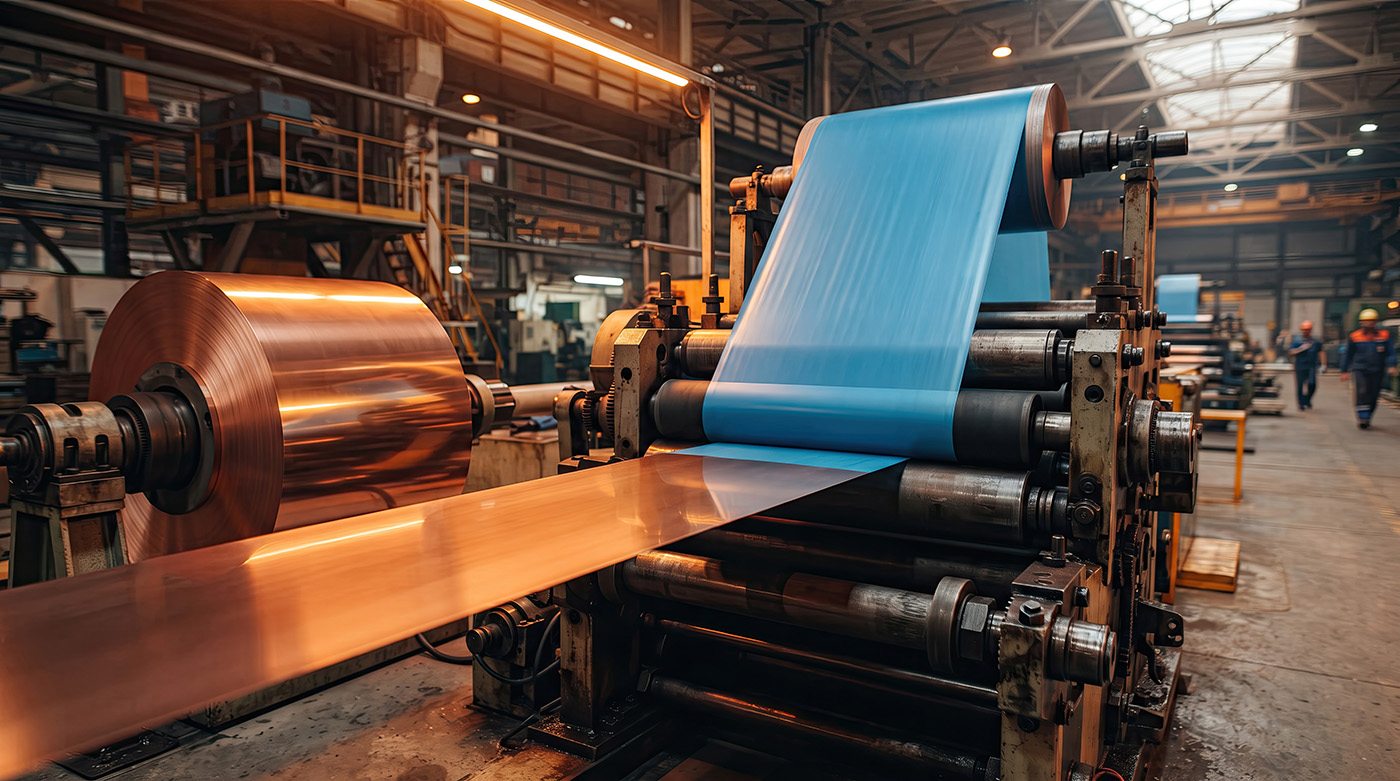
The rolled material must pass through the rolling stands in hot rolling mills precisely centered and with a consistent thickness. If conventional position control systems have mechanical play, this disrupts the process. That is why we use solutions with direct encoder connections instead of distribution gearboxes and additional couplings. This design is compact, has no mechanical play, and—thanks to fiber-optic cables—ensures EMC-compliant signal transmission.
Mechanical Play as a Source of Error
In older rolling stands, the position of the side guides and thickness control are usually still managed by mechanical switches and encoders. However, the distribution gears and additional couplings used for this purpose are often prone to errors. Their mechanical play results in positions being detected inaccurately. If the strips are subsequently not centered correctly or if the thickness cannot be adjusted precisely as a result, this impairs the process and, consequently, product quality.
Compact directly mounted solution with Hübner Giessen
A rolling mill customer wanted to eliminate the inaccuracies caused by mechanical play and was looking for suitable directly mounted solutions for the side guides and thickness control. We were able to offer him a compact and future-proof solution with our modular U-ONE universal encoder system. The electronic encoder system can be easily expanded at any time and not only increases precision but also ensures EMC compliance thanks to fiber-optic signal transmission. To learn more about what such a directly mounted solution looks like, read our case study “Case Study: Rolling Mills/Side Guides and Screw Downs—Higher Control Accuracy in Hot Rolling Mill due to direct Encoder Attachement.”